Wednesday, 23 May 2012

From seed to social enterprise

¡Hola todos! It's been a while. But after a couple weeks of vacation, and a couple more weeks of school (but still pretending I'm on vacation), I'm back up and blogging!

Over the Victoria Day weekend, I had the wonderful opportunity to enjoy some fresh air, and pay some visits to two friends who have just started exciting new green businesses in the Waterloo Region! Let me introduce you.

Rachel Dyck - Gardener extraordinaire, growing ideas from the ground up!

Forget mindless summer jobs. Rachel has something better in mind -- a summer spent learning new skills, helping her neighbours, and taking care of the environment!

Inspired by a conversation with  the University of Waterloo's own Economics professor, Larry Smith, Rachel has launched Gardens to Grow, a budding container gardening business. "Manageable, affordable and sustainable," Gardens to Grow starts vegetable gardens from seed, and sells them for $35 each in ready-to-go containers.  Customers have the choice of 3 different gardens, "Italian Blend," "Summer Salad Bowl," and "Veggie Variety."  Gardens to Grow makes it possible for anyone, even those with no yards or gardening skills, to enjoy garden fresh herbs and vegetables!

Container vegetable gardening is a simple way for urbanites to reduce their food miles and carbon footprints, afford healthier food, and learn about the process of food production! It's a great idea for a growing city like Kitchener-Waterloo. And the people of Waterloo seem to think so too, judging by the number of orders that have been rolling in for Rachel's beautiful bushel baskets. As we've been learning in our social entrepreneurship class, this intersection of supply and demand is the sweet spot for success, and the mark of a true opportunity! I'm inspired by Rachel's vision, and I'm excited to see her business grow. 

To learn more about Gardens to Grow and order your own container garden, visit http://gardens2grow.blogspot.ca/.


Nathan Klassen - Friendly face at your local farmers' market!

If the talented buskers in front of his stand at St. Jacob's Farmers' Market don't draw you in (*cough* field placement fundraising *cough*), Nathan's bounty of beautiful organic produce will!

A recent graduate of the University of Guelph's BSc program in Organic Agriculture, Nathan recently fulfilled his dream of buying his own farm, and founded Nith Valley Organics.  Vegetables, herbs, meat, eggs, plants--you name it, Nith Valley sells it. And better yet, the plants and vegetables are all farmed using organic methods!  Nathan hopes that the farm will achieve organic certification within a few years.

Nith Valley also has an active Community-Supported Agriculture (CSA) program, which allows community members to share in the risk and the bounty of the enterprise by purchasing "farm shares". How do organic farms and CSA programs promote social and environmental values?  CSAs help consumers get to know the producers of their food, and engage in the food production process.  CSAs promote community health by providing members with fresh, healthy food. Some CSAs even allow members to participate in farm work in exchange for discounts on food boxes, making organic food more affordable to low-income community members.  In addition, by CSAs support environmentally sustainable farming methods, by providing organic farmers with a steady cash flow.

All of these social and environmental benefits make me excited to see new farmers who are passionate about organic farming and Community-Supported Agriculture! It's great to see that there's an alternative to the industrial food system that is rich in nutritional, social, and environmental value. And it sure tastes good!

Dig in! Look for Nith Valley Organics at your local farmers' market, or visit them online at http://www.nithvalleyorganics.ca/index.shtml.


- Laura -

Monday, 9 April 2012

Field Placement Update!

So, I have some exciting news...

I just accepted a new field placement as Community Network Development Advisor at CEDEMUNEP, the Centre for Black Peruvian Women's Development (Centro de Desarrollo de la Mujer Negra Peruana)!  This is a pretty big change, as I was originally going to be working with youth on a wetland conservation project in the Amazon, and will instead be living and working in the bustling cities of Callao (the port district of Lima) and Chincha.  But it's an exciting opportunity, because I think this new position will be a much better fit.

"CEDEMUNEP is a non-profit organization founded in Lima, Peru in 1997, with a mission is to promote the rights of Afro-descendant populations, with particular emphasis on Afro-Peruvian women and gender equity and equality. CEDEMUNEP brings the voices and perspectives of Afro-Peruvians to the formal political process and delivers programs to strengthen their socio-economic, organizational, and political development.


CEDEMUNEP’s projects revolve around fostering the integral development, cultural identity, and participation of Afro-Peruvian women in the decision-making processes, and non-discrimination and prevention of violence against them.

MATCH, WUSC and the CEDEMUNEP will work in partnership with Afro-Peruvian women organizations in Peru to promote the political participation and leadership of Afro-Peruvian women. The Project will train emerging and established leaders as well as build an Action Plan for a network of Afro-Peruvian organizations to work together on shared objectives."

I chose this organization because of the incredible work they are doing to empower black woman leaders in Peru, giving them a voice in politics, raising the profile of Afro-Peruvian issues, and strengthening their development and integration into society.  Working at CEDEMUNEP will be a great way to connect work in the field with my local experience as a community organizer in Waterloo, engaging with students and community members to work for social and environmental justice.  I'm excited to have the chance to work in urban community development, and explore the possibility of building a career in this field!

The future is bright :) 

Monday, 2 April 2012

So you want to be President

My jaw dropped last week when I saw the news that Jim Yong Kim might become the next World Bank President. In case you're thinking, "I know that guy--he looks at things!," Jim Yong Kim is not to be confused with Kim Jong-Il, the late leader of North Korea.  "But then who is he?"  You may ask.  Don't worry, you're not alone.  Obama definitely got some blank stares when he announced his nomination.  But that's probably because Kim has not spent his career munching sandwiches at elite tea parties--he's spent his career in the field with Partners in Health and the World Health Organization, fighting the root causes of infectious diseases and working with the poor to revolutionize community-based public health care systems in countries all over the world.  And that's why Jim Yong Kim and his vision for an "open, inclusive World Bank" are just what the doctor ordered.  

These are just a few reasons why I'm excited about Kim's nomination:
  •  He believes that good health and education are foundational for sustainable, inclusive economic growth.  This marks a huge departure from the World Bank's failed Structural Adjustment Programs of the 1980's and 90's, which forced developing countries to cut social spending in the name of economic growth.
  • He gets good results.  The success of his radical Partners in Health model in treating diseases like multi-drug-resistant tuberculosis led to the model's adoption by the World Health Organization, and its expansion to 12 countries.  Later, as director of the WHO's HIV/AIDS program, he led the incredible "3x5 Initiative" which has now treated more than 7 million Africans with HIV/AIDS. 
  • He defies stereotypes.  When he became President of Dartmouth College, he was the first Asian-American to become president of an ivy-league college.  If he is chosen as the World Bank President, he will be the first Asian-American, physician, anthropologist, and development professional to take the position.
  • He does development from the bottom-up.  Partners in Health successfully built capacity and accountability in developing countries by training Community Health Workers and valuing local knowledge and capabilities.  Kim also believes in the importance of economic growth with equity, a concept which the World Bank hasn't seemed to grasp.  
  • He can sing, dance, and even rap ? 
But not everyone is excited about Kim's nomination.  Critics are saying:
  • He is anti-growth
  • He doesn't have the right experience (Former World Bank economist and NYU professor William Easterly said, "You have to have the mind-set to allocate scarce funds, rather than approaching the problem as if we have unlimited resources for suffering people.")
  • The U.S. should not have complete power over who is selected
 First of all, as I mentioned before, he believes in a symbiotic relationship between health and education and economic growth. He is also a proponent of growth with equity.  But maybe more importantly, isn't anyone talking about the end of economic growth?  Second, I think it's clear from any biography of Kim that he is incredibly qualified for the position.  As far as needing to make decisions about "scarce funds" goes, I think it's more important to have people in high positions of power who recognize the abundance of our resources, and have radical visions for re-distribution and economic equality.  Finally, when it comes to the U.S.'s power in the selection process, I agree that it's time that other countries had a say.  But I still think that Jim Kim would make a great president, and I'm excited about the possibilities for the World Bank with Kim at the helm.  

 
 So here are my questions for you:
  • What do you think about Kim's nomination?
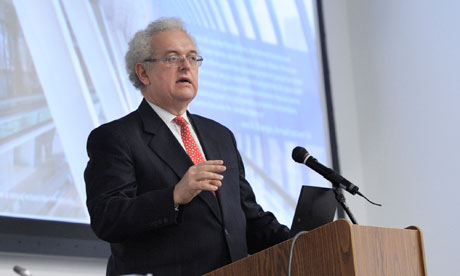
  • How do you think he stacks up against the competitors, Nigeria's Ngozi Okonjo-Iweala and Colombia's José Antonio Ocampo (also incredible, and many say better candidates)?
  • Should the U.S. be able to select the World Bank President?
  • If you were World Bank President, what would you change?
Let's discuss! Comment with your thoughts and opinions!


Friday, 23 March 2012

Maybe it's the weather or something like that

Climate change is a hot topic these days!  Just this week, UW's Everyday Radicals organized the university's first-ever mp3 flash mob to raise awareness about climate change, and 350.org announced their next big day of action.  And it found its way into all of my class discussions, whether the topic was incorporating environmental considerations into business practices, planning for tomorrow's cities, or providing clean drinking water for the world.  I once heard someone describe the climate as the rug underneath development, because all development activities are built on the underlying assumption of the climate's stability.  Pulling out the rug will change everything. 

What I want to discuss today is the topic of "climate refugees"--those displaced by climate change.  Experts have warned that climate change could cause the largest refugee crisis in human history, and it's been estimated that 200 million people could be displaced by 2050.  The movement will be unpredictable--many people will migrate temporarily and internally as storms and floods inundate their homes, but many people will have to relocate permanently and internationally--notably, Pacific Islanders whose countries are actually at risk of disappearing due to sea level rise.  42-50 small island states could disappear within the coming years! But this is not just a future problem--already, islanders are suffering from cyclones, droughts, and floods.  Obviously, this is an urgent issue that calls for action from political leaders.

But what kind of action? This depends on the way we frame the issue.  In my political science class, we recently discussed McNamara & Gibson's article, "We do not want to leave our land," in which the authors talk about Pacific ambassadors' resistance to the term "climate refugees".  It turns out that many islanders actually don't like the term because it makes them appear helpless in the eyes of the world, when really, they are taking amazing steps to prevent climate change.  They also think that the term takes responsibility away from developed countries to actually reduce emissions and prevent climate change, because the developed countries can just focus on accepting migrants instead.  They are unwilling to accept displacement as their new reality and want developed countries to take action now. 

So, what do you think?
  • Does the term "climate refugees" do more harm than good when it comes to supporting those at risk of displacement due to climate change?  
  • Does focusing on climate change migration take away from efforts to prevent climate change?

Let's discuss--comment with your ideas and opinions!

Friday, 16 March 2012

All that glitters is not gold

Peru has been in the headlines of major world newspapers this week, with the recent demonstrations by miners in Madre de Dios, an important gold-mining region in Peru's eastern Amazon.  The high price of gold over the last few years has sparked a gold rush in southeastern Peru that has drawn thousands of miners to the region and caused fears of ecological disaster.  The government recently toughened sanctions that would punish illegal gold miners and environmental lawbreakers with 10 years in prison, and the miners have taken to the streets in protest.  Since government-miner negotiations broke down on March 6th, more than 5,000 people have taken part in the protests, which ended yesterday after 3 people died and more than 30 were injured.  I have only begun to read about the issues at play, but I'm getting the sense that the situation is enormously complex. To try and make sense of it all, let's look at some of the different perspectives represented in the recent BBC article:

The Protesters
  • The miners say the law will put thousands out of work. An estimated 50,000 miners do not have a license to operate.
  • They want the government to overturn the tough sanctions 
  • They argue that the government is clamping down on wildcat miners instead of helping them to obtain authorisation. "Illegal miners have been trying to get the right permits," said spokesman Jose Carlos Bustamante, "but (we) couldn't because of bureaucratic hurdles for the past three years."
  •  The miners accuse the government of wanting to hand over mining concessions only to large multinational companies.
  • "Like it or not the economy of our region is based on mining," says the mayor, Pedro Donayre, a former miner, who no longer wants his town to be on the margins of the law. "I'm in favour of mining but it does need to be legitimised. The state needs to come here and educate the miners how to extract the gold safely without polluting and help us change rather than demonising what we do."
     
The Government
  • The sanctions will encourage miners to get permits and stop polluting the environment
  • The government says large areas of jungle (close to 200 sq kms) have been destroyed by illegal mining and large portions of the area's waterways show high levels of mercury, used in the mining operations. "The western Amazon is the world's enclave of biological diversity," says biologist Ernesto Raez, who heads the Environmental Sustainability Centre in Lima's Cayetano Heredia University.
  • The informal sector has grown out of control, and now almost a quarter of the gold produced in the world's sixth largest producer is illegal. The vast majority of it comes from Madre de Dios. 
As Regional President Luis Aguirre has said, the situation seems to be "untenable".  Negotiations are scheduled to resume on Monday, but both groups' positions seem to be as entrenched as ever.  How can the government work together with miners to prevent ecological destruction, and assure that they still have a source of income? Do you think that the government is actually interested in this, or is the government just using the environment as an excuse to exclude the people of Madre de Dios from the mining industry? 

Let's discuss!

Wednesday, 7 March 2012

Community at Home

Featured at seekingcommunity.ca on March 5, 2012 as Part 3 of a 3-part series on my trip to Jubilee

Last night, it was wonderful to meet up again with the group of twelve Conrad Grebel students who travelled to Jubilee Partners two weeks ago.  It's amazing to be part of this community that is growing out of a desire to learn more about community.  As we sat in a circle and enjoyed a potluck feast, we shared our reflections on the trip and engaged in a fascinating discussion about the possibilities for intentional community in our own lives.

One of the things that struck me most about Jubilee Partners was the strength of both the community and the individuals who live and work there.  While many intentional communities dissolve because of interpersonal conflict, Jubilee has remained a strong and dynamic community for over 30 years.  The Partners’ faith and common commitment to living Christian lives has carried them through even the most difficult times, and the importance of their mission of hospitality continues to motivate their daily work.

Community seems to happen naturally at Jubilee, but our learning sessions with the Partners made us aware of how much work goes on behind the scenes to keep the community running smoothly.  It was clear to us that the weekly work schedule was integral to life at Jubilee.  It equalized people by dividing up difficult jobs.  It gave everyone, even visitors, a role in the community and ensured that time was spent purposefully.  It also ensured that the community accomplished everything it wanted to do.  So often in our individual lives, we make resolutions to improve ourselves or live out our values, but we “run out of time” to do these things.  But at Jubilee, when the community decides to take on a project, it gets done because people are simply scheduled to do it.  A little discipline, routine, and accountability in daily living can go a long way, considering how much anxiety and frustration we experience when we feel that are not living out our values.

Discipline—especially spiritual discipline—is also a very significant source of personal strength for the Partners.  Don Mosley, one of the founding Partners, shared with us some stories from his life.  I’ll never forget his statement that a productive life is a prayerful life, not a busy life.  All of the Partners spend time in prayer and worship each day, which brings them peace and strength to make it through tough times.  The book, With Our Own Eyes, described the early days of Jubilee and made it clear that the community’s decision to spend more time in prayer was a major turning point in their history, and completely changed how they approached their daily lives and work.  I think that their incredible ability to resolve conflicts and live well together is largely the result of their spiritual discipline and their individual commitment to live out love.

It was interesting for me to return from this trip at the beginning of Lent, which, for Christians, is a season of repentance and re-focusing on God and relationships.  The last two weeks since Jubilee have been a very meaningful time for me as I reflect on my priorities in life and how I can live more intentionally in relation to God, the earth, and the people around me.  Right now, this means adopting a practice of daily journaling, which I hope will allow me to reflect on my daily living and relationships, and find the strength to live the life that I want to be living.  It also means entering into discussion with others about the possibilities for living in intentional community now and in the future.  Our trip to Jubilee has already inspired some incredible ideas and discussions, and I am excited to see what is in store for the future! I have a feeling that this is just the beginning of something great.

A Window Into Community Life

Featured at seekingcommunity.ca on Feb. 24, 2012 as Part 2 of a 3-part series on my trip to Jubilee

My time at Jubilee has been incredible so far. The Partners have so generously welcomed us into almost all aspects of their shared lives. In this blog post, I’ll give you a glimpse into life at this long-standing intentional Christian service community.  

An important part of community life is shared meals.  Twice a day, the bell rings and invites everyone in from the fields and forest for delicious lunches and suppers in the Koinonia House.  Before lunch, there is always a time of worship, which includes scripture reading, reflection, prayer, and group singing.  I have been impressed by the way that people of all ages and cultures are involved in these worship services.  On the first day, a 5-year-old led a song in his native Karen, and the community songbook is filled with songs in many languages.  After worship, lunch is served.  The community’s food ethics are evident in the meals.  As much food as possible is grown at Jubilee (the rest is purchased or donated by the food bank), meat is only served on Sundays, and dessert is only offered twice a week.  The meals are all very satisfying and healthy, especially when accompanied by great conversation.  And everyone, no matter their status in the community, shares in meal preparation and clean-up.  Many hands make light work!

This is also true for the chores that fill the working hours of the day.  Everyone, even visitors, take part in the work.  Although the daily schedule is fairly routine, tasks vary from day to day, keeping things relatively interesting.  As university students who rarely get the chance to detach ourselves from computers, we are thankful to take part in outdoor jobs, such as mulching, chopping wood, and harvesting food.  My favourite job so far has been helping out with the ESL classes for refugees.  I took part in the intermediate class on Tuesday and pretended to be a new neighbour to the 5 Karen women in the class, so that they could practice English phrases for inviting people over, giving people directions, and initiating small talk.  The spirit of hospitality was even present in this class, as one of the women actually invited me over to her house afterward, even though I was a complete stranger to her.  In everything we do at Jubilee, relationship-building seems to be just as important as the task at hand, and there is always room for meaningful conversation.  And while everyone shares in the less-glamourous tasks like cleaning, everyone seems to be able to focus their time on jobs that they find meaningful and interesting, like working in the garden, caring for refugees, or doing pastoral work.  Because of this, and because all of the work is clearly essential to the service work and daily functioning of the community, everyone seems to have a strong sense of purpose and motivation.  While work is casual, no one looks over each other’s shoulders, an incredible amount is accomplished and people feel very satisfied at the end of each day.  

My experiences of community life at Jubilee have been very positive so far, and I look forward to writing more about the community’s work and philosophy in a later post.  Needless to say, the trip has been very impactful so far, and is inspiring many thoughts and ideas around communal living.