Monday, 19 November 2012

Journal, November 5

Last Tuesday, theory met practice at the Afro-Peruvian Roundtable’s discussion on “The Afro-Peruvian People and their inclusion in the Political Constitution of Peru.”  I was excited that my supervisor had invited me to attend, as the theme of the discussion was directly related to my INDEV 474 research paper on the collective identity and rights of Afro-Peruvians.  I looked forward to learning more about a topic that I had already researched extensively, and hearing from Afro-Peruvians themselves, rather than North American academics’ perspectives on Afro-Peruvian issues. 

 I arrived early at the Afro-Peruvian Museum, where the event was to be hosted, and so I had the chance to wander through the exhibits while I waited for the discussion to begin.  Historical drawings of African slaves waiting on their Spanish colonial masters gave me a glimpse of Afro-Peruvians’ long history of humiliation and exclusion from society, while rooms full of percussive music and videos of traditional dances filled me with a sense of their cultural richness and strength as a people, despite centuries of hardship.  After reading about their incredible political achievements in recent years, including the government’s 2009 Historic Apology, I entered the meeting with a feeling that Afro-Peruvians were riding a tide of success, and that there was much hope for their future.

However, as four o’clock came and went, and the small group of eight Afro-Peruvian civil society leaders realized that no one else would be coming to the event—not the congressmen who had confirmed, nor the Minister of Culture—the feeling of humiliation and exclusion became real.  The discussion was moved from a large event hall to an actual roundtable, at which I even had a seat.  At first, the discussion had a fairly negative tone, as the group felt somewhat defeated before they had even begun.  However, they soon turned to constructive conversation on the rights of Afro-Peruvians and strategies to realize them.

From what I understood of the rapid and intense discussion, the main issue regarding Afro-Peruvians’ inclusion in the Constitution is that they self-identify as a distinct racial and ethnic group, needing special civil and political, as well as economic, social, and cultural rights.  They do not, however, fit into the state’s definition of an “indigenous people” that would be guaranteed these rights, and so they do not receive the special protection that indigenous groups do.  My research paper explored the justification for their claims to racial and cultural group identities, and found that they were, in fact, justified in claiming both.  I wanted to go further in my analysis and make recommendations for policy changes; however, I struggled to determine which definitions of racial and cultural groups were of significance to Afro-Peruvians.  At this roundtable, I learned that the important definition is that of the International Labour Organization, which states that an “indigenous people” is one that was present during the period of conquest or colonization, or when the state’s borders were established.  Clearly, this definition excludes groups that are original to Peru, but that developed after the state was established.  This leaves no path for Afro-Peruvians to claim the kinds of rights they need for protection against past and present discrimination, and the preservation and development of their unique culture.  I now know that for Afro-Peruvians to be included in the Constitution, this definition needs to be expanded.

The Roundtable discussion was necessary for clarifying the group’s goal of modifying the state’s definition of a “people.”  However, it may be a struggle for the group to gain the political leverage needed to accomplish this, as government leaders clearly do not care enough to sit down and work together.  The vision for the Roundtable is to be a space for dialogue between the political administration and civil society, but it remains to be seen whether or not the political administration shares this commitment.    

Tuesday, 23 October 2012

Journal, October 22

                From the moment that I arrived at the office last Tuesday morning, I felt welcomed into the CEDEMUNEP family.  I was greeted by my two new co-workers with warm hugs and kisses, and I took my place by their sides, working hip-to-hip in our tiny apartment-office in Lima.  Over the last two weeks, we have learned to communicate across the language barrier and work together effectively.  As it is my first time working internationally, and their first time hosting an international volunteer, it is a learning experience and an exercise in patience for all of us.
          When I first arrived last Tuesday, I sat down with my co-workers for tea and conversation about their current projects.  As a civil society organization that is highly responsive to the needs of the community, CEDEMUNEP is engaged in many diverse activities, ranging from a clothing drive for a town devastated by an earthquake, to summer education programs for youth in Lima.  They are also currently providing legal and psychological support to a young woman who was raped in June of this year, and whose case is being ignored by the judicial authorities.  My supervisor explained that the woman, Carmen, was working as secretary to the mayor of a nearby town, when she was drugged and raped by the mayor with the complicity of several colleagues.  Because of the political nature of the case, and because Carmen is Afro-Peruvian and poor, the authorities are trying to sweep the incident under the rug.  CEDEMUNEP was asked to get involved, and so we are working to break the silence and put pressure on the judicial authorities to issue a court ruling.  Cecilia explained to me that we would be writing a letter to the crown attorney, which would be sent out to organizations in our regional, national, and international networks for them to endorse.  I thought it was a great idea, until I realized that the “we” she was talking about was me.  I would be writing the letter—in Spanish.  
           I awkwardly tried to explain that my Spanish writing abilities were fairly basic, but my speaking ability was also poor enough that I did not quite communicate this critical point, and a few minutes later, I found myself staring at a blank Word document with a pile of confusing papers in my lap to work from.  It was one thing to write a paragraph about women’s issues in Spanish class—it was quite another to feel that the future of Carmen’s case rested on my ability to write a grammatically-correct, and even convincing letter that would achieve the endorsements of hundreds of civil society leaders and eventually be read by the crown attorney.  Talk about responsibility.  Despite my lack of confidence, I told myself that I had come to Peru to help in any way that I could, and that I should at least try.  After hours of untangling the messy details of the case, I finally began to grasp what had happened, and outline a letter.  With much assistance from a dictionary, I was able to complete the letter one day later.  My co-workers were thrilled and I was proud, and together we made some final corrections and began to mail it out.
         When I had the opportunity to meet Carmen and her mother the next day, and listen to her talk about the challenges she has faced over the last few months, I was completely humbled by her courageous and relentless pursuit of justice—not just for herself, but for all victims of sexual violence in Peru.  When I gained a little perspective, I saw that my own challenges in writing a letter paled in comparison to her struggles with the entire government system.  Not only that, I grieved that my inarticulate letter could have more political power in Peru than her own voice.  When she looked me in the eye and thanked me for my help, I finally realized that the responsibility that I had been entrusted with was no longer something that I wanted to run away from, but rather something that I wanted to fulfill to the best of my ability.  Like my friends at CEDEMUNEP, I hope that I may have the courage and strength to fight for justice until the very end. 

Journal, October 8

            It has been a quiet week in Lima.  With a four-day weekend last week, and now a three-day weekend, I have had a lot of time to rest and prepare myself to start work this week at CEDEMUNEP (the Center for Black Peruvian Women’s Development).  I have been looking forward to Tuesday ever since I visited CEDEMUNEP two weeks ago.  It is a small organization with only two full-time staff members, who will become like family to me.  They are very active in the community, running workshops almost every week for women and youth on topics such as health, domestic violence, and self-esteem.  They also work at the national and international levels to advocate for Afro-Peruvian rights, and fight against racial discrimination in Peru.  At the beginning, while I am still learning Spanish, I imagine that I will work mostly in the office, assisting with research on violence against Afro-Peruvian women, and helping to organize programming.  However, I hope that my Spanish will improve rapidly so that I will be able to begin working in the community.
          Having volunteered for the last few years as a student organizer, I feel that I have some experience in community social and environmental justice education.  However, my experience is mostly in working with highly-educated, English-speaking, middle-class people whose life experiences are similar to mine.  It is quite another thing to enter into a community that is not my own and pretend that I know anything about racial discrimination or domestic violence.  What is my role in this situation?
           I have spent some time exploring this question this week, and have found a lot of wisdom in the writings of Myles Horton, the founder of the Highlander Folk School, which works to promote education and development in Appalachia.  In his account of the Folk School’s beginnings, he talks about how the staff—young, idealistic, university graduates—made the mistake of thinking that they could take what they had learned in university and “tailor it” to the needs of the community.  In Horton’s (1998) words,
We still thought our job was to give students information about what we thought would be good for them.  Whenever they had a problem, we would try to figure out what in our bag of tricks would apply to that problem, and we would adapt it and make it fit the situation.  We ended up doing what most people do when they come to a place like Appalachia: we saw problems that we thought we had the answers to, rather than seeing the problems and the answers that the people had themselves (p. 22). 
He goes on to explain that the teacher’s role is to help people respect, analyze and learn from their own experiences.  Once they can do this, they will be able to solve their own problems (Horton, Kohl & Kohl, 1998).  This is an important lesson, and I hope to apply it in my work at CEDEMUNEP.  It is a relief to know that I don’t have to have all the answers!

 Horton, M., Kohl, J., & Kohl, H.  (1998).  The long haul: An autobiography.  New York: Teachers College Press, p. 22. 

Journal, September 24


I am certain that I have used up all of my nine lives in these past two weeks.  While I could have died nine deaths from the threatened traveller’s sickness, sidewalk attacks, air pollution, traffic accidents, yellow fever, typhoid, runaway parades, embarrassing moments, or sheer lack of sunlight, water, and soil, I have somehow been spared from all of them—at least for now.  Either I am a savvy traveller, have incredible luck, or the guidebooks were just wrong about Lima, Peru. 
My experience of Lima has been very narrow so far—limited to just three of the wealthiest districts—but it has surprised me in many ways.  The city that one website called “out of control” with violence and crime turns out to be tranquil, except at rush hour, and festive at the best of times.  In the past few weeks, I have learned to let down my guard, because this so-called “developing” city is not asking anything from anyone, except maybe recognition of its development.  In downtown Miraflores, the upscale district of Lima, I see fewer beggars than I did in Uptown Waterloo.  The streets are cleaner and the transportation is faster.  And yet the city begs to be seen as “modern.”  The word is everywhere—on signs for new high-rise residential buildings and in tourist brochures.  After decades of playing development catch-up and trying to forget its turbulent past, Peru wants to be counted among the big players, and yet plays on different strengths than most of the world’s powers.  At Mistura, now the second-largest gastronomic festival in the world, Peru boasted a world-class cuisine and showcased its incredible biodiversity, which one Peruvian called a “gift from God.”  Indeed, Peru has been blessed with many life-giving resources, but some, such as gold, are both gifts and curses.  Towering Scotiabank skyscrapers in San Isidro are beacons for international mining companies, which are received warmly by many for the economic development they bring to the country.  But anyone who reads the newspaper and follows the citizen protests in cities like Madre de Dios knows that this wealth comes at a cost to many rural communities that are involved in informal mining activities, or that want to preserve the natural environment.  But in districts like Miraflores and San Isidro, which only see the benefits of this economic “development,” these issues seem faraway and largely invisible.
My experience of Lima so far has been much like my experience of Spanish conversations.  I think I understand, but my knowledge is so basic that I cannot always distinguish between what I understand and what I cannot.  But in the case of Lima, I know that I am only seeing the clean, shiny surface and missing a lot of what goes on here.  It’s nice to feel comfortable in my guest house in San Isidro, but I am looking forward to starting work next week at the Center for Black Peruvian Women’s Development, where I hope I will begin to see a more colourful picture of Lima.  

Saturday, 6 October 2012

Mistura

 
We had first heard about Mistura from last year's students, who said it was a must-see, and they were right!  As the second largest gastronomic festival in the world, there were thousands upon thousands of vendors who converged on the park in downtown Lima.  When we first got there, we were given maps of the different dishes/drinks and regions represented at the festival.  We didn't know where to start, and spent probably an hour just wandering around wide-eyed, trying free samples.


 Eventually, the guys settled on ceviche (the most popular dish in Peru - fresh raw fish marinated in citrus juices) and anticuchos (beef heart kebabs), while Annie and I opted for mixed platters of sausages, juane, and platanos (bananas) from Tarapoto, a town in the Peruvian Amazon.  Later on, we had churros filled with chocolate and manjar blanco (dulce de leche), and smoothies made with exotic fruits.  Que rico! 


But my favourite part of the festival was el mercado, the market that surrounded the monument in the centre of the park.  Unlike the vendors outside who were selling hot dishes, the vendors in the market were selling whole fruits, vegetables, tubors, grains, and drinks.  It was an incredible display of Peru's rich biodiversity, and I learned the names of more foods than I could remember in a lifetime. 

The vendors, many of whom were indigenous folks from the mountains or the Amazon, were dressed in elaborate and beautiful traditional clothing.  Mistura was an amazing opportunity to see a real cross-section of the Peruvian population.  In Peru, la comida nos une.  Food unites us. 


Orientation Week

Orientation began bright and early the next morning, when Irma knocked on the door of my room.  After I had her repeat whatever she was trying to tell my in Spanish about five times, I finally understood that Julio was waiting for us outside. What?! Despite everyone's talk about "Peruvian  time," I had made a point of being on time on the first day, just in case people were more punctual in the city.  But not only was Julio on time, he was 15 minutes early! That, I was not expecting. Emily and I finished getting ready in about 5 minutes, and the guys weren't far behind.


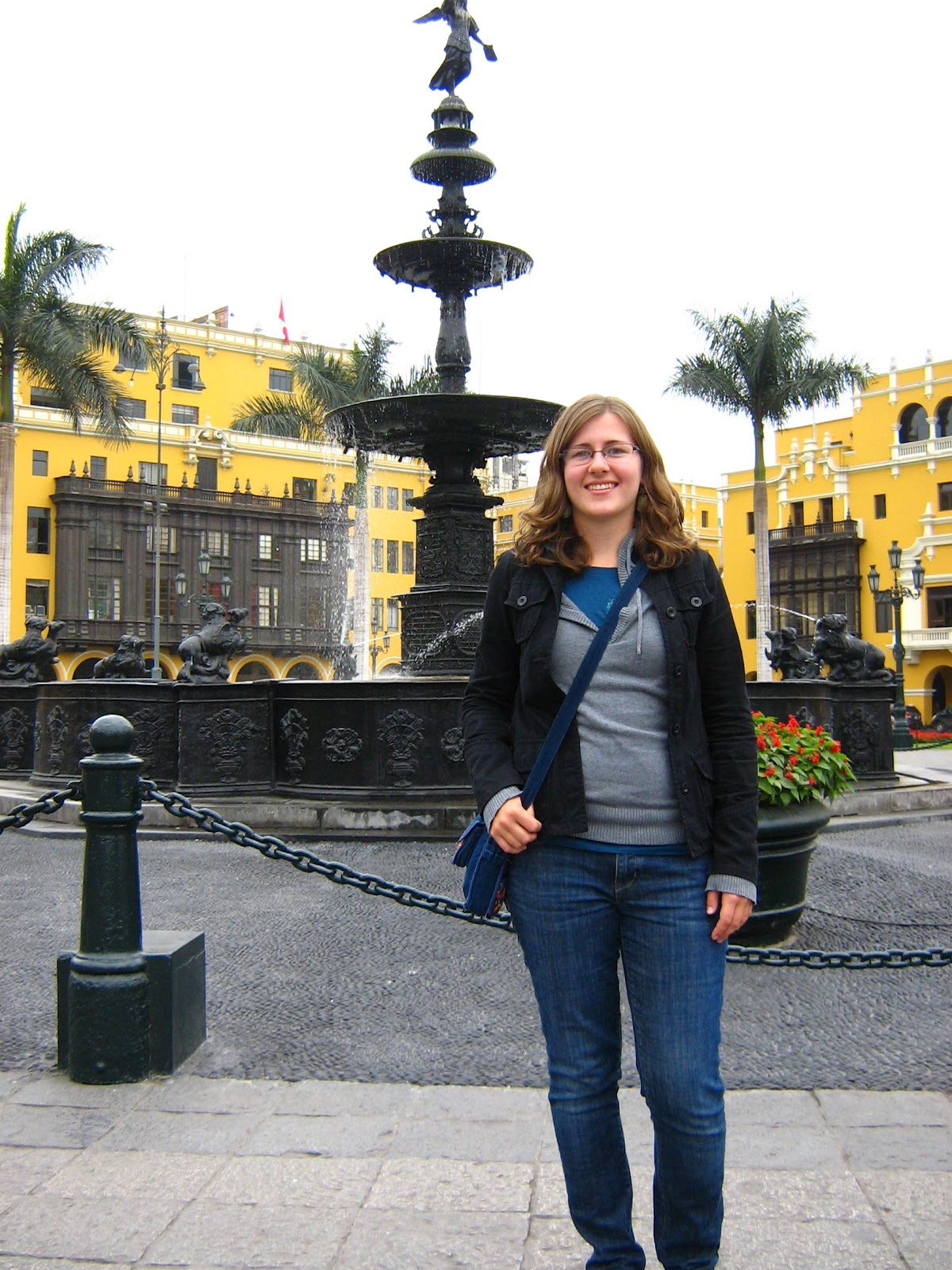
We made our way slowly through the insane rush hour traffic and arrived safely at the SUM Canada office in Miraflores.  This is where we started each day during orientation week: in a lovely meeting room, where we listened to presentations on everything from safety to government structure, while snacking on cookies and delicious pear juice.  Then after a huge lunch of chicken, seafood, or Chinese-Peruvian food (chifa) we would do some sightseeing around the city.  The municipal building, the presidential palace,the national library, art galleries, Larcomar, Larco streeet, Plaza Mayor, Plaza San Martin, cathedrals and more cathedrals--we saw the best of Miraflores, the tourist district, and El Centro de Lima, the historical district.  We also ran countless errands, diving in and out of taxis at currency exchange houses, the lawyer's office, the cell phone stand at Supermercado Wong, and on and on. 

Needless to say, by the time we got home in the evenings, we were exhausted.  I was so grateful that I didn't have to cook for myself, and I enjoyed the meals that Sonia prepared, although they had a lot more meat than I was used to.  Unlike most Westerners, I had hoped for more rice and beans!  They do love rice and beans here, but it's just one of thousands of national dishes.  I mean, there are almost 4000 varieties of potatoes alone! (and I'm sure that about half of the national dishes are some variation on chicken and rice and/or potatoes).  Needless to say, KFC is popular here. But thankfully we've avoided KFC so far, and had had some incredible food experiences.  First among them was Mistura.

On our way

Emily, Keith, Manny, Dan, and me
On Monday, September 10th, I stood in the kitchen at 5am with Dan, Manny, my family, and our friends, Mike and Meg, eating Mom's homemade muffins and choking down my first dose of Dukoral as I prepared to leave for Pearson International Airport.  After a night of packing and no sleep at all, my body was running completely on adrenaline, and I could only hope that I had packed everything I would need for the next 8 months in my suitcase, which was miraculously 1.5 lbs under the weight limit (whew). My suitcase and my mind were full, although there was a lot that I was leaving behind, and the future, to me, was as foggy as the Lima sky.  I thought of something I had once read: You can only see as far as your headlights, but you can make the whole trip that way.  I hoped that my limited Spanish, my plane ticket and passport, and the name of our taxi driver would be enough to get me where I needed to go.  After a rushed goodbye on our dark driveway and a short drive to the airport in Toronto, I was off on my biggest adventure yet.

Toronto --> Houston --> Lima

By the time we were on the plane, I had been able to let go of most of my anxiety and just enjoy the flight.  But one worry still occupied my mind--Spanish.  My Spanish was so rusty. Who was I kidding?  How was I possibly going to get by?  But before I had much time to worry, I ended up sitting next to a friendly young Peruvian woman.  A native of Ayacucho, she had been living in Whistler, BC for the last 10 years, and was very sympathetic of my language woes.  For the first couple of hours, we enjoyed conversation about Peruvian culture in English. And then, almost seamlessly, we just switched into Spanish.  I could do it! I was going to be fine.  It was exactly the warm-up that I needed to ease my transition from Canada to Peru, and I'm so thankful for her insight and encouragement. 

Despite some delays, we arrived in Lima on time and were met with warm hugs and kisses from the SUM Canada (WUSC Peru) team.  Julio helped us pile our luggage into the  trunk of his taxi van, and we climbed in, eager to see the city of Lima for the first time.  If I was a bit disappointed by the city, whch at first glance seemed austere and a bit gloomy, my disappointment was overshadowed by my happiness at actually having arrived, and the friendliness of Isabel and Julio.  I had made it. I could do this.  

After almost an hour, we finally arrived at our destination: la casa de Margarita, the guest house where I would be living and where Manny, Emily, and Dan would be staying during orientation.  Keith had gone straight to the guest house where he would be living in Miraflores.  We were greeted at the door by Irma, who showed us to our rooms.  I was asleep almost as soon as my head hit the pillow.